
How to Spot Management Potential Before a Promotion
 Publié le 24 August 2026
On Friday, the promotion email goes out, and everyone agrees it is deserved. The person being celebrated knows the work inside out: the fastest closer on the sales floor, the technician everyone consults first, the analyst whose reports never come back with corrections. There are handshakes, congratulations, maybe a cake if the office is feeling generous.
On Monday, the same person walks into a different job. An underperformer is waiting who needs coaching, not covering for. Two colleagues have a disagreement that will not dissolve just because someone new holds the title. Work has to be delegated to people who will do it differently, and probably slower, than the new manager would. And at some point this week comes the honest feedback conversation with a former peer they had drinks with on Friday, a skill nobody asked them to demonstrate before handing over a team.
Nothing about knowing the work prepared them for any of that. The gap between what earned the promotion and what the role demands is where most promotion mistakes live. It is also visible before the title changes hands, if you know where to look.
The Promotion Trap Starts With the Wrong Evidence
The instinct behind that Friday email is reasonable. Output is measurable, tenure feels fair, and technical mastery is easy to defend. The trouble is that these answer a different question. They describe how someone performs in the job they have. They say almost nothing about what happens when the job becomes other people’s performance.
Most organizations still promote this way, and the results are on record. Gallup surveyed U.S. frontline supervisors and found that 65% got the role based on performance or years of experience in a frontline job. Only 30% were selected for supervisory skills or experience. Gallup also measured how engaged those supervisors now are in the job, and the split follows the selection method: 31% among those promoted on performance, 42% among those chosen for supervisory skill.
Sales research tells a similar story, with a caveat worth keeping. The NBER study on promotions tracked salespeople who became managers and found that the better their own sales numbers had been, the worse their new teams performed. Each doubling of pre-promotion sales came with a 7.5% drop in the performance of every subordinate the new manager took on. Pre-promotion collaboration experience predicted better outcomes. The study covers sales alone, and what holds on a commission floor will not map neatly onto a clinic or an accounting team. Still, the direction matches what the survey data keeps showing: individual excellence and management contribution are separate quantities.
None of this makes strong performance irrelevant. It remains a fair admission requirement, and a promotion that ignored it entirely would create its own resentments. What performance cannot do is settle the question on its own: it gets a candidate into the conversation, and the conversation then needs different evidence. The discipline is familiar from hiring pipelines, where the teams that improve are the ones that measure the signals that predict the role rather than the ones easiest to count.
Define the Management Job Before Judging the Person
The assessment cannot start with the candidate. It starts with the role, because different management jobs demand different behaviours. A promotion decision needs a specific target to compare evidence against.
The National Research Council of Canada’s people-management profile is a useful public model of what those behaviours look like written down. It describes coaching others, providing regular feedback that names both success and the need for improvement, evaluating performance fairly, resolving interpersonal problems that affect work, developing individual careers and team capability, and dealing promptly with ineffective performance. Each item is an activity someone either has or has not demonstrated. That is what makes the list usable in a promotion decision.
The list also needs trimming to the actual role. A shift supervisor in a plant spends most management time on workload, schedule fairness, and quick conflict resolution. A sales manager lives in coaching conversations and pipeline reviews. A technical lead may manage two people and an architecture, which weights judgment and knowledge-sharing over formal evaluation. Five or six behaviours, chosen for the specific role, are enough.
Write the short list down before any names are discussed. The next two steps depend on it existing.
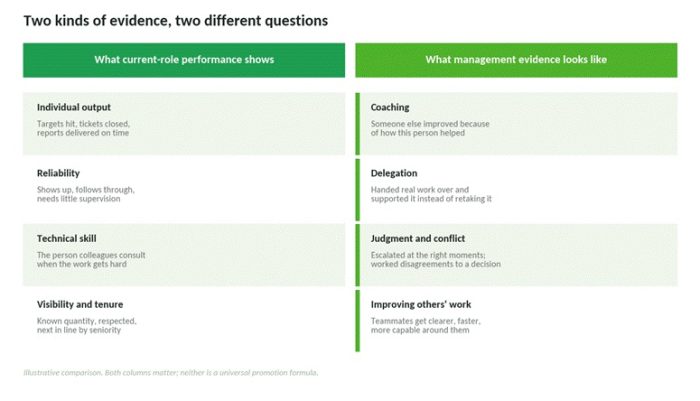
An illustrative comparison of what current-role performance shows against what management-role evidence looks like. Alt text: two-column table contrasting individual output, reliability, and technical skill with coaching, delegation, judgment, conflict handling, and improving other people’s work. Credit: original graphic, illustrative example only.
Look for Evidence That Changes Other People’s Work
With the role defined, the search changes character. You are no longer asking whether the candidate is impressive. You are asking whether other people become more capable when this person is involved, and that evidence lies in ordinary moments rather than in performance reviews.
Some of it is already on record. The colleague who trained the last two new hires without being asked, and whose trainees ramped up faster than usual. The senior technician who handed a visible project to a junior and spent the week answering questions instead of taking it back. The analyst who talked two disagreeing teammates into a shared definition of the problem before it reached their manager. Each of these is a small, checkable event, and a few of them together say more about management potential than a year of individual numbers.
The question that separates the useful stories from the flattering ones: what became clearer or better for someone else because this person stepped in? Doing a struggling teammate’s work for them produces gratitude and no growth. Making the teammate able to do it next time is the management behaviour. The distinction sounds small and is the entire job.
Judgment and communication leave traces of the same kind: the moment someone escalated at the right time instead of heroically absorbing a problem, or made a complicated situation understandable to a colleague from another department. That second one is a conversation managers have every day.
One caution on promotion sourcing. Candidates narrating their own collaboration are describing their intentions, and intentions polish well in retrospect. Ask the people who were coached, delegated to, or argued with, and treat what they describe as the record of what actually happened.
An illustrative evidence map crossing four management behaviours with three independent evidence sources. Alt text: grid mapping coaching, coordination, judgment, and follow-through against observed work, input from people affected, and a structured interview or work sample. Credit: original graphic, illustrative example only.
Test the Role Before Handing Over the Title
Observed history will not cover every behaviour on the role list. Test the rest deliberately. The core principle comes from structured interviewing: ask every candidate the same predetermined, job-related questions, and rate the answers on the same scale. Consistency turns impressions into comparable evidence. It also protects the process from the halo of the strongest individual performer.
Pair the questions with one or two realistic simulations. Keep them short and role-specific. Score them against the behaviour list, not against general impressiveness:
- Coach a struggling employee in a role-play, then explain the reasoning behind the feedback approach.
- Delegate a time-sensitive project, specifying who decides what and when to escalate.
- Work through a conflict between two team members without smoothing over the underlying disagreement.
- Deliver difficult feedback to a peer while keeping the working relationship intact.
Write down what a strong answer looks like before running any of these. Rating against a pre-agreed standard is what keeps the exercise honest when the popular candidate stumbles. For reference designs, the UK Civil Service behaviours framework shows behaviour-based assessment documented at scale, though a private employer should treat it as an example rather than a rulebook.
A temporary stretch assignment can add real-world evidence too: leading a small project, covering a supervisor’s vacation. Give it clear expectations, defined decision rights, and support. Left vague, it becomes unpaid shadow management, and the evidence it produces is mostly about endurance.
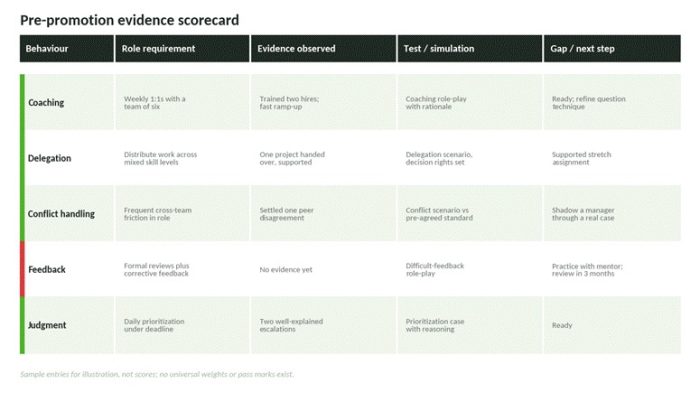
An illustrative pre-promotion evidence scorecard mapping five management behaviours to role requirements, observed evidence, tests, and development gaps. Alt text: worksheet table with columns for behaviour, role requirement, evidence observed, test or simulation, and development gap or next step. Credit: original graphic, illustrative example only.
Turn the Gaps Into a Development Plan
Most candidates come out of this process with a mixed scorecard. And that, believe it or not, is an outcome that’s more useful than disappointing. “Not ready yet” is a development finding. It means the organization now knows which two or three behaviours stand between a promising employee and a promotion that will actually work.
This is where a competency matrix earns its place, as a running comparison between the behaviours the role requires and the evidence each person has shown so far. The gaps it exposes convert directly into development moves. Someone who has never delivered hard feedback gets coaching practice with a mentor. Someone who has never delegated gets a supported stretch assignment. Someone who avoids friction shadows an experienced manager through a real conflict. Set a review point a few months out, with a date on the calendar rather than a vague “we’ll revisit,” so the plan has a real horizon and the employee knows the door is open.
For some strong performers, the honest finding will be that management is not the right use of them, or not what they want once they see the job up close. That deserves a real individual-contributor path with advancement and pay attached, not a consolation prize as people tend to leave organizations that offer expertise only one direction to grow.
Promote the Evidence, Not the Reputation
The decision rule at the end of all this is short but proven. Promote when the role’s core behaviours show up across more than one source of evidence: observed history plus a structured test, rather than reputation plus enthusiasm. Develop first when the gaps are specific and coachable, with a named plan and a review date. Keep a genuine specialist track open for the people whose best contribution was never going to be management.
Think back to the Friday email. The version worth sending celebrates something the organization has already watched happen. It goes to the colleague who has coached, delegated, settled disagreements, and told people hard things well, in small doses, before the title made any of it mandatory. A promotion should confirm evidence you have already seen, not launch a Monday-morning experiment with a team attached.