How Employee Monitoring Software Supports Better Team Accountability
 Publié le 16 July 2026
What if the biggest threat to your team’s success isn’t poor hiring practices, but a lack of awareness of the work being done?
A few years ago, managers could walk a floor, read a room, and sense the energy of a productive team without checking a single dashboard. Accountability rarely needed to be measured because it was embedded in the environment. Nobody had to name it or force it. It just existed.
Then remote work reshuffled everything. Teams are scattered across cities and time zones. Kitchen tables replaced cubicles. And that natural visibility vanished almost overnight.
Employee monitoring software stepped into that gap, and before you picture some setup with cameras watching people eat lunch, know this. The category has evolved dramatically.
The tools gaining real traction today work more like shared scoreboards than hidden cameras. When companies get team accountability right with these tools, the conversation shifts from “prove you’re working” to “let’s look at the work together.”
The Problem Nobody Solved by Pretending It Didn’t Exist
In 2025, Gallup found that only 54% of managers strongly trust their remote teams to be productive when working out of sight. That figure doesn’t point to poor management. It highlights a real visibility gap created by remote and hybrid work.
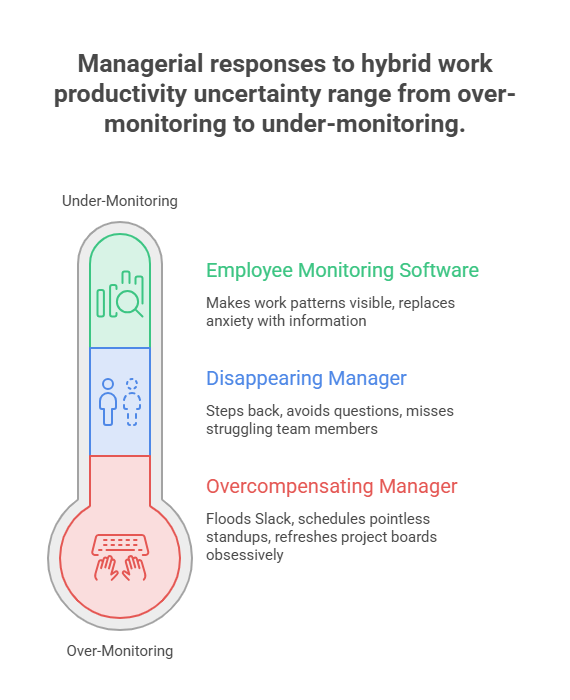
When managers are unable to identify effective employees, what happens? There are two possible scenarios, and neither is good.
The Overcompensating Manager
The anxious ones go into overdrive:
- Flooding Slack with constant status requests that eat into working hours
- Scheduling pointless thirty-minute standups every single morning
- Turning project management boards into surveillance instruments, they refresh all day obsessively
Their teams feel suffocated. Workplace productivity tanks because half the day gets burned on reporting instead of doing. The talented people start interviewing elsewhere within months. Understanding management styles through DiSC profiles can help organisations identify whether a manager leans towards control or collaboration before the damage is done.
The Disappearing Manager
Then there’s the type who decides asking questions equals micromanaging, so they step aside. Sounds progressive until a struggling team member goes six weeks without feedback, and missed deadlines start piling up before anyone notices.
Where Employee Monitoring Software Fits In
Both responses wreck team accountability from different angles. Same root cause, though: no reliable information about how work is going.
That’s the gap employee monitoring software closes by making work patterns visible enough. Performance tracking replaces anxiety with real information. Organisations serious about closing that gap sustainably often work with IPB Partners to align their management frameworks before rolling out new tools.
Self-Generated
What People Get Wrong About These Tools
Quick question. When you hear the term “employee monitoring software,” what comes to mind? Keystroke counters? Screenshots every ninety seconds? Webcam footage on some server?
Fair enough. Those tools exist. But they represent the bottom of the barrel, not the standard. Lumping all workforce management tools into that category is like judging every restaurant by the worst fast food chain you’ve ever eaten at.
The platforms that companies with high retention rates use in 2026 track patterns and outcomes rather than pixels and keystrokes. Modern employee monitoring software is built around giving teams shared visibility into work patterns rather than spying on individual screens.
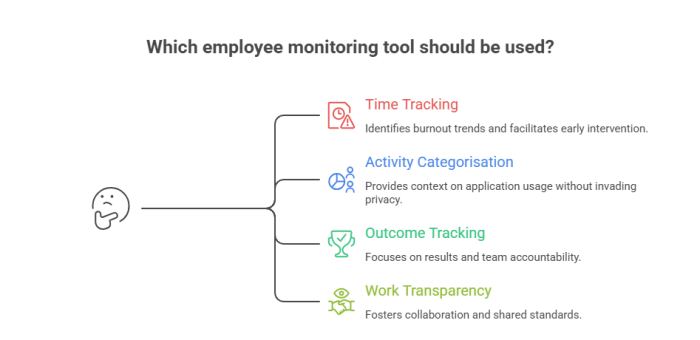
Time Tracking That Spots Problems Early
Good time tracking isn’t about catching someone who clocked in late. With tools like Time Doctor, the real value lies in surfacing dangerous trends before they become bigger problems. If your top salesperson has been logging eleven-hour days for two months straight, you don’t need a screenshot. You need a conversation before burnout turns into a resignation.
Activity Categorisation Without Crossing Lines
Productivity tools sort application usage into broad buckets instead of recording every click. A marketing coordinator bouncing between Canva and Google Analytics? Productive. Four hours deep in YouTube and Reddit? Different conversation. Employee oversight at this level gives managers context without capturing private messages or exposing browsing history.
Outcome Tracking Where Team Accountability Gets Real
This is where team accountability stops being theoretical. The strongest employee monitoring software doesn’t care how many hours someone logged. It cares whether the deliverable is shipped. Did the milestone get hit? Did the task move from “in progress” to “done” on schedule? Performance tracking built around results changes accountability conversations entirely because nobody can argue with what got finished.
Why Work Transparency Ties Everything Together
When the same numbers are visible to the employee and the manager, standards stop being handed down from above. They become shared. Employee oversight feels collaborative rather than punitive. And that’s where you want team accountability to live.
Self-Generated
The Research That Should Change How Every Company Thinks About This
You’d think that monitoring employees would automatically make them work harder. Logical assumption. Totally wrong.
A 2025 study from MIT and UC San Diego, published through the National Bureau of Economic Research, tested this with 434 remote workers. When monitoring was introduced with zero explanation, workplace productivity fell by about 17 per cent. People didn’t step up under observation. They withdrew. Stress rose. Employee engagement dropped.
Performance held steady. In some cases, it ticked upward.
Same tools. Same dashboards. Completely opposite results. The only variable was whether someone had a human conversation before flipping the switch.
What Companies Getting This Right Actually Do
The technology is neutral. What makes it help or hurt team accountability comes down to habits like these:
- Apply monitoring to every level, not just junior staff. When the VP’s calendar data sits in the same system as the intern’s activity log, the message is clear: this is about visibility, not control. Employee engagement survives because nobody feels singled out.
- Lead with support, not suspicion. “Your numbers dipped this week. What do you need from us?” lands completely differently than “Explain why your activity score dropped Thursday afternoon.” Employee oversight that starts with curiosity keeps people. Employee oversight that starts with accusation loses them. We spoke with several team leaders about how accountability works inside distributed teams, and Latoria Williams from 1F Cash Advance shared a similar perspective. According to her, shared visibility into progress helps managers identify bottlenecks earlier, support employees before deadlines slip, and keep accountability tied to outcomes rather than activity alone. In practice, this creates a stronger sense of ownership across the team and reduces the need for constant check-ins.
- Let employees see their own data. Transparency in the workplace must be reciprocal, or it won’t exist at all. Team members begin self-correcting without an awkward meeting when they are able to examine their own time monitoring trends and productivity patterns. Self-directed team accountability is superior to manager intervention.
Trust inside remote teams either strengthens or breaks down based on whether accountability feels like a shared project or a top-down imposition. Visible and honest data makes the difference.
Where Oversight Stops Helping and Starts Hurting
There’s a fine line. Every organisation that uses employee monitoring software has to find it, and a lot of them find it the hard way, after good people have already left.
Strong remote workforce management strategies all centre on the same fundamental idea. Positive results are achieved only when employee oversight is combined with genuine autonomy, explicit expectations, and open communication. Monitoring becomes hazardous nearly instantly if you remove any one of those.
Self-Generated
Here’s a quick look at what earns genuine buy-in versus what pushes people out the door:
| Earns Buy-In | Pushes People Out |
| Explaining what data gets collected and the reason behind it before any tool gets installed | Quietly adding tracking software to devices and hoping nobody notices |
| Building performance tracking around shipped work, completed milestones, and finished deliverables | Logging every keystroke, grabbing screenshots, and recording webcam footage |
| Opening up dashboards so employees can see their own patterns and self-correct | Locking all the data behind manager-only access and revealing it only during write-ups |
| Same rules for the CEO as for the recruits | Softer standards at the top, strict enforcement everywhere else |
The organisations that pull value from employee monitoring software treat it as a team transparency project. Not a surveillance operation. The distance between those two things is small in theory and enormous in practice.
None of This Works Without the Culture to Back It Up
Employee monitoring software layered on top of a broken culture just makes the dysfunction louder. Bad communication gets worse. Managers who blame instead of coach now have data to weaponise.
Only when the basis is already sound can monitoring increase workplace productivity:
- Regular one-on-one conversations where people can be honest
- Goals that the team sets together and genuinely understands
- Recognition that feels specific and earned rather than generic and automated
Performance tracking and time tracking hand you raw numbers. Team accountability turns those numbers into forward motion. But the bridge between the two will always be human.
By 2033, the market for employee monitoring software is expected to reach 4.74 billion dollars. These tools for productivity are here to stay. The only pertinent question is whether your organisation will utilise them for surveillance or assistance.
Are you ready to foster an atmosphere at work where accountability and trust coexist? Check out Jobillico.com‘s hiring insights, workforce management strategies, and career tools to get started.